PIPELINE.
Our vision is to be the trusted engine for regeneration — advancing restorative medicines through world-class technology and deep therapeutic partnerships.
Our vision is to be the trusted engine for regeneration — advancing restorative medicines through world-class technology and deep therapeutic partnerships.
We believe we can unlock regenerative cell therapy across many therapeutic areas, including diseases such as Parkinson’s, liver diseases, type 1 diabetes and other diseases of the central nervous system.
We know the immense potential to cure chronic and degenerative diseases, but traditional approaches often struggle with scale, efficiency and integration.
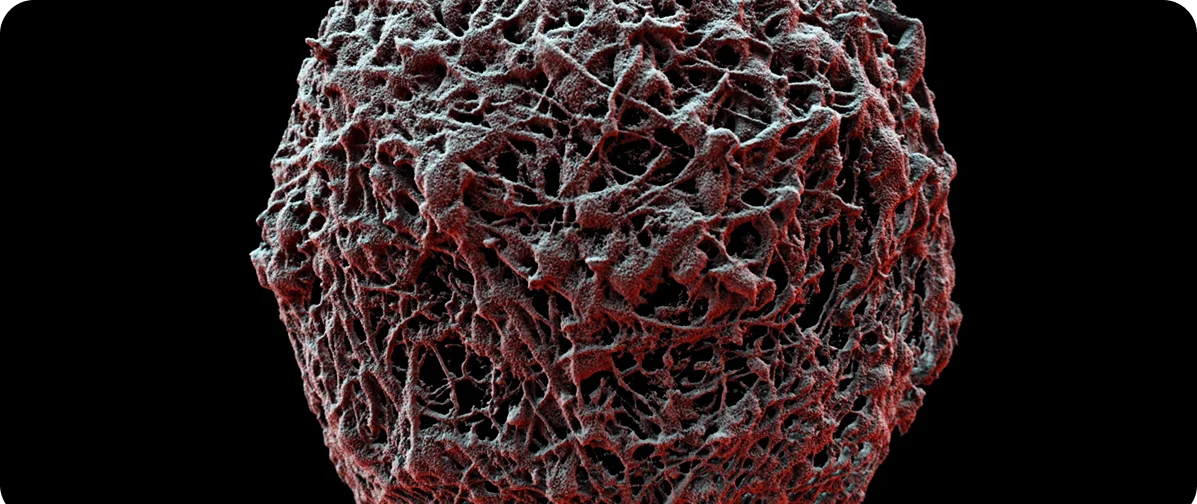
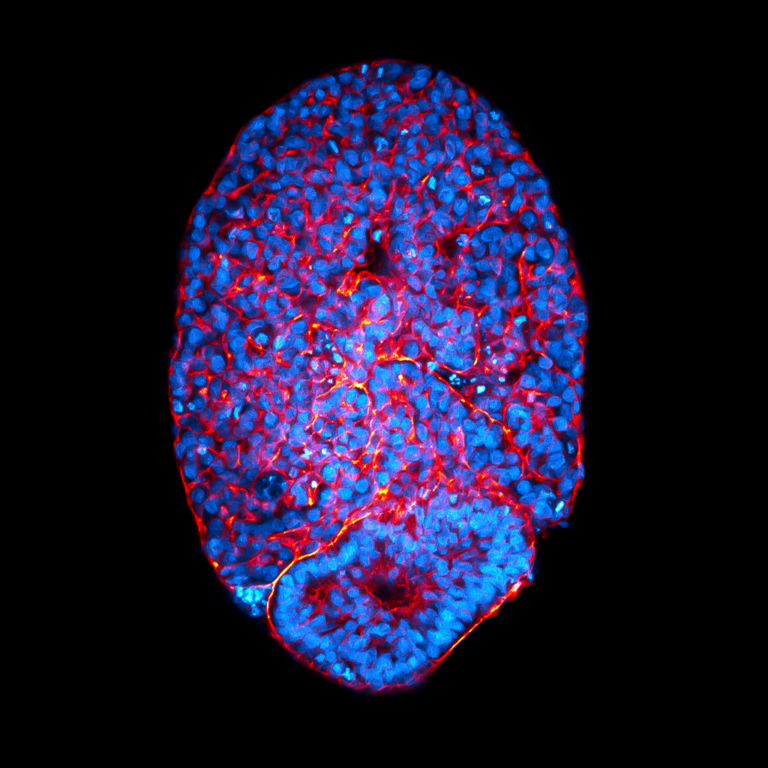
Our proprietary and partnered pipeline leverages the power of C-Stem™, generating unique iPSC-derived 3D microtissues that act as functional, ready-to-transplant tissues facilitating efficient integration and fast onset.
Through our existing programs and partnerships, we are on track to help millions of people live healthier, brighter futures.
Learn more about C-Stem™In Parkinson’s disease, an estimated 60–80% of dopaminergic neurons are already lost before motor symptoms even appear. The nigrostriatal pathway degenerates, destroying the essential wiring that connects dopamine-producing neurons to movement control. While chemical dopamine replacements (like levodopa) can manage symptoms, they cannot restore the spatial precision, feedback loops, or dynamic regulation of a healthy brain network.
To achieve true functional restoration, it is not enough to simply replace lost cells; the brain’s circuitry must be rebuilt. This is called reinnervation and transplanted cells need to survive, mature, extend new axons into the host tissue, and form functional synapses.
Scientific evidence shows that the extent of reinnervation is directly linked to the therapeutic efficacy of the graft. TFG-001 has been engineered to conquer this biological challenge.
Learn more on reinnervation here →TFG-001 is a first-in-class 3D neural microtissue. Composed of both mature dopaminergic (DA) neurons and DA progenitors, this 3D format is designed to enhance post-transplantation integration and reinnervation.
Unlike single-cell suspensions, which must re-establish connections with each other and the host tissue, its pre-organized 3D dopaminergic network, comprising both progenitors and neurons, facilitates more efficient integration and markedly improves reinnervation capacity
3D neural microtissues (dopaminergic neurons and progenitors).
The graph summarizes the level of dopamine release obtained with the Drug Product, after thawing, 2 days of subculturing and 1 hour of stimulation in KCl-rich medium.
This graph highlights batch-to-batch consistency, including for the batch produced after tech transfer, as well as the stability of this potency 1 year after production.
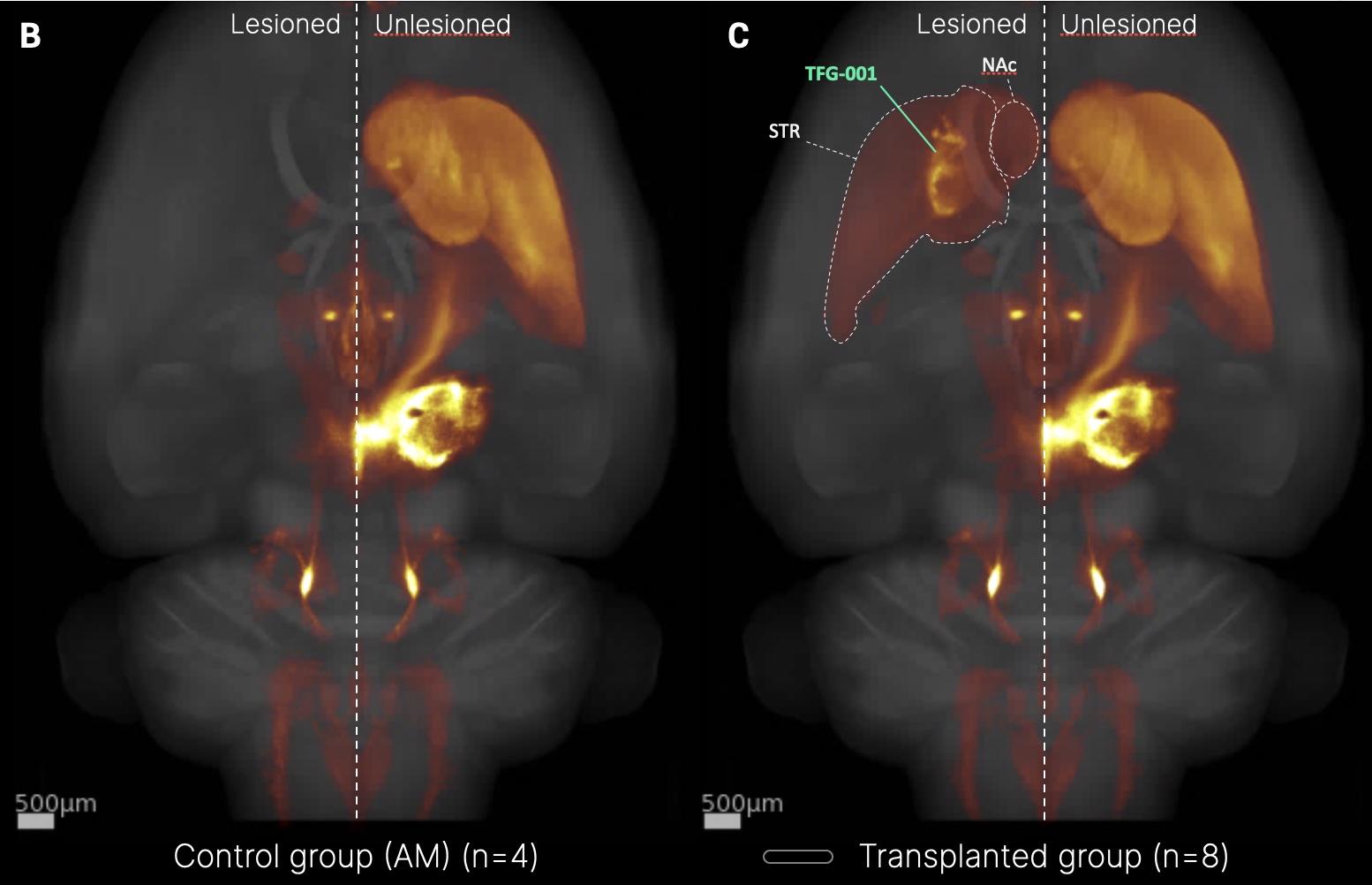
In vivo studies show average accumulated intensity of the TH signal after TFG-001 transplantation, across the experimental groups. In this graph, brighter color indicates higher signal intensity.
This rapid recovery is fully sustained long-term.
The graph shows the efficacy in months with cryopreserved microtissues showing functional recovery at 13 weeks in preclinical rat models (green line).
Cryopreserved 3D microtissue with no delay in time-to-effect vs fresh product, maintaining dose-dependent recovery.
— Publications
Learn more about our platform and Parkinson’s through our publications
TFG-001 is on track for a First-In-Human (FIH) clinical trial application (CTA) by 2027. We are actively exploring opportunities for the co-development and commercialization of TFG-001
There is a critical, unmet need for off-the-shelf hepatic solutions to support patients experiencing serious liver diseases such as acute liver failure. Extending patient waiting times for organ transplants or ensuring hepatic function while the liver naturally regenerates is a global healthcare priority.
The liver features highly complex tissue architecture that cannot be accurately replicated by traditional 2D flat cell cultures. Our solution relies on ready-to-transplant 3D hepatic liver microtissues derived from induced pluripotent stem cells (iPSCs), which perfectly suit the complex architectural needs of the liver.
Treating liver disease requires massive doses—over 5 billion cells per patient. Our C-Stem™ amplification technology is uniquely designed to meet this demand, on track to producing >200 billion cells per batch required for commercial and clinical viability without compromising cell quality.
The graph demonstrates that C-Stem™ enabled a higher amplification rate leading to a higher cell yield at the end of the differentiation. In red: capsule; in blue: 2D static culture.
Engineered to deliver the structural and functional fidelity required for therapeutic application.
The graph shows the albumin secretion, which is detected earlier and at a higher level in the microtissues differentiated in capsules than in the cells generated in 2D. In addition, the CYP3A4 activity and urea production at day 30 of the differentiation are higher in the microtissues differentiated in capsules than in the cells generated in 2D.
Validated across the criteria required for clinical translation.
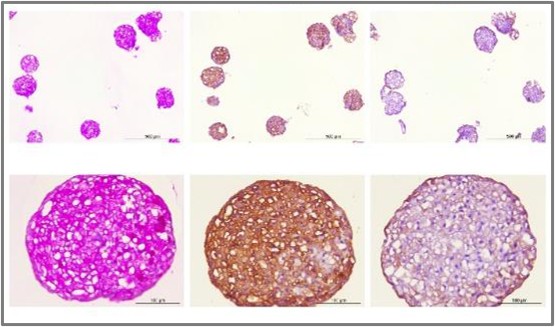
The hepatic microtissues in graph show organ-like cellular organization that recapitulates morphological and functional features of a liver, composed of cells with characteristic cubical morphology and hepatic functions (albumin production, glycogen) and those of cholangiocytes (CK19-positive cells) forming biliary structures.
Functional performance comparable to primary human hepatocytes with C-Stem promoting the microtissue functionality and formation of organized hepatic microtissues
We are open to exploring partnership opportunities for co-development in liver diseases.
The trusted platform for regenerative medicine.
We are actively exploring opportunities for the co-development and commercialization of TFG-001 — and for targets across the brain, heart, liver, and pancreas.